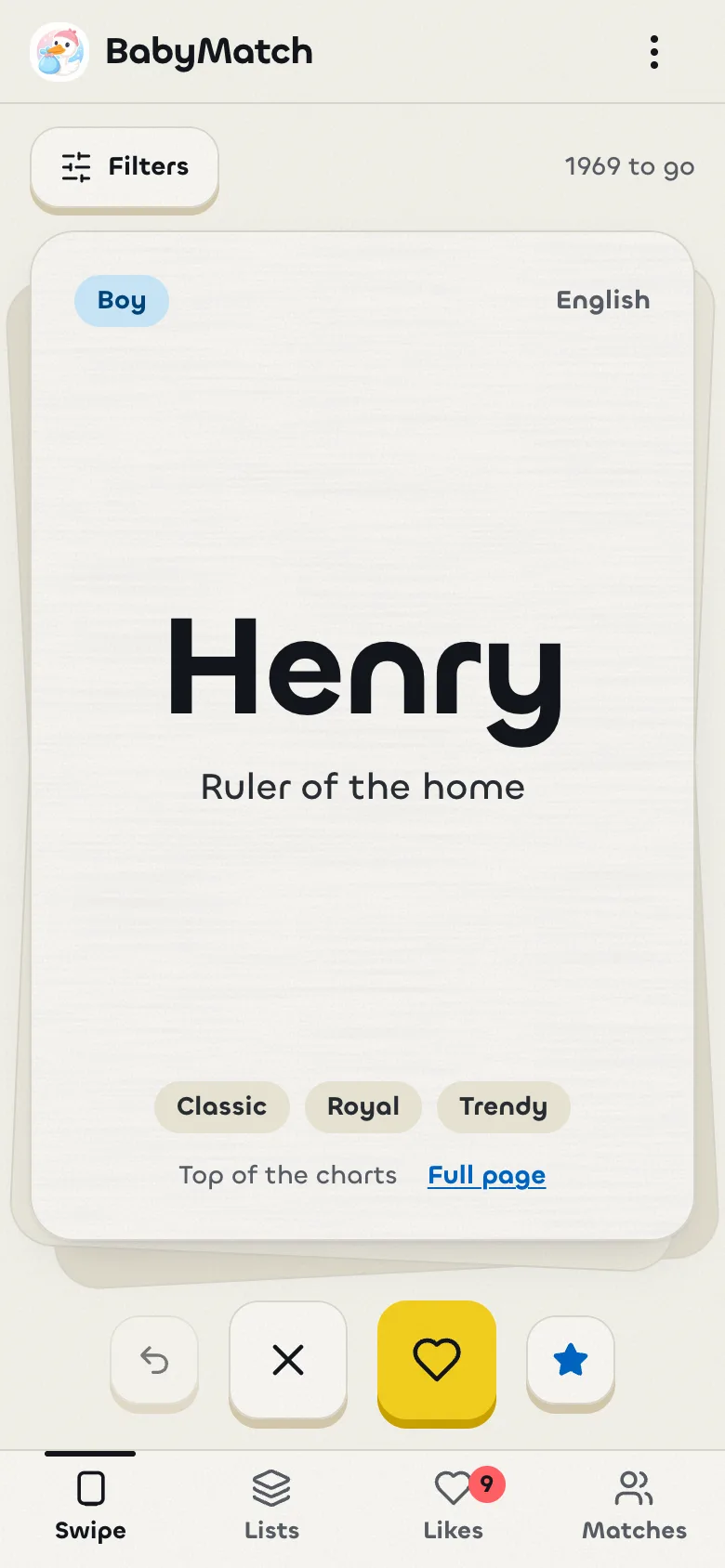
Emma
Emma is a girl’s name of Germanic origin that means “Whole, universal”. You will meet it among English, German and Spanish names.
Questions about Emma
What does Emma mean?
Emma means “Whole, universal”.
Where does the name Emma come from?
Emma is a name of Germanic origin. You will meet it among English, German and Spanish names.
Is Emma a girl’s or a boy’s name?
Emma is a girl’s name.
How common is the name Emma?
On a five-step scale from “Very rare” to “Top of the charts”, Emma sits at “Top of the charts”. United States (SSA, 2025): Emma ranks no. 3 among girl names.
Which famous people are named Emma?
Well-known people named Emma include Emma Watson, Emma Goldman, Emma Thompson, and Emma Roberts.
When is the name day of Emma?
The name day of Emma is June 27, the feast of Hemma of Gurk.
How many people are named Emma?
United States: 776,439 births with the name Emma since 1880. Its best year was 2003, with 22,719. France: 175,980 births with the name Emma since 1900. Its best year was 2005, with 7,075. Italy: 77,674 births with the name Emma since 1999. Its best year was 2012, with 4,971.
What sibling names go with Emma?
Names of a similar style and origin go well with Emma, such as Victoria, Alexandra, Arthur, and Alexander.
What middle name goes with Emma?
Combinations such as Emma Victoria, Emma Charlotte, and Emma Julia sound good.
Famous people named Emma
- Emma Watson1990English actress (born 1990)
- Emma Goldman1869–1940Russian-born American anarchist (1869–1940)
- Emma Thompson1959English actress and screenwriter (born 1959)
- Emma Roberts1991American actress (born 1991)
- Emma Raducanu2002British tennis player (born 2002)
- Emma Bunton1976British singer (born 1976)
People with a Wikipedia article, best known first. Data from Wikidata.
Name day of Emma
The name day of Emma is June 27, the feast of Hemma of Gurk.
- Hemma of GurkJune 27Carinthian princess, founder of Catholic churches and monasteries, and saint (c.980-1045)
- Emma ÜffingSeptember 9German Catholic nun (1914-1955)
- Emma of LesumDecember 3German countess
Dates taken from Wikidata. The same saint can be celebrated on different days depending on the country or calendar.
Emma in numbers
United States: 776,439 births with the name Emma since 1880. Its best year was 2003, with 22,719. In 2025, 12,754 babies received it.
By decade of birth
In other countries
- France: 175,980 births with the name Emma since 1900. Its best year was 2005, with 7,075. In 2025, 2,310 babies received it.
- Italy: 77,674 births with the name Emma since 1999. Its best year was 2012, with 4,971. In 2025, 2,332 babies received it.
- Spain: 47,562 people are named Emma. Their average age is 16.1. It ranks no. 99 among girl names. 1.9 in every 1,000 carry it.
Source: Social Security Administration, Baby Names from Social Security Card Applications – National Data. Data as of December 31, 2025. Public domain (work of the U.S. government). Source: Social Security Administration Source: Insee, Fichier des prénoms (état civil), naissances 1900–2025. Data as of December 31, 2025. Licence Ouverte / Open Licence 2.0 (Etalab). Source : Insee Source: Istat, rilevazione "Iscritti in anagrafe per nascita" (Conta nomi). Data as of December 31, 2025. CC BY 4.0. Fonte: Istat Source: INE (Instituto Nacional de Estadística), Apellidos y nombres más frecuentes. Censo anual de población. Data as of January 1, 2025. CC BY 4.0. Elaboración propia con datos extraídos del sitio web del INE: www.ine.es
Emma in the national rankings
- United States (SSA, 2025): Emma ranks no. 3 among girl names. In 2024 it ranked no. 2.
- Germany (GfdS, 2025): Emma ranks no. 2 among girl names. In 2024 it ranked no. 3.
- France (INSEE, 2025): Emma ranks no. 7 among girl names. In 2024 it ranked no. 5.
- Spain (INE, 2025): Emma ranks no. 9 among girl names. In 2024 it ranked no. 10.
- Italy (ISTAT, 2025): Emma ranks no. 11 among girl names. In 2024 it ranked no. 10.
Sibling names that go with Emma
For a sister
Picked for a style, origin and popularity close to Emma, with a different initial.
Middle names for Emma
Combinations picked for how they sound together: a different rhythm, no repeated ending and no clashing vowels.